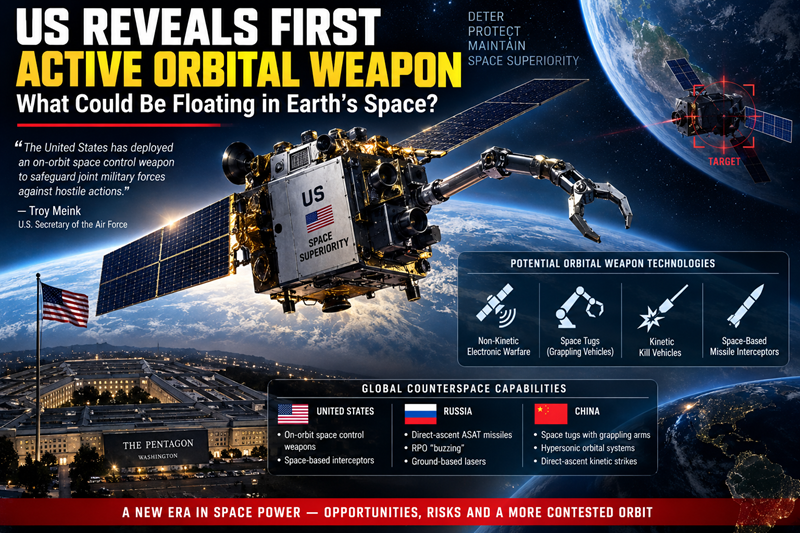
WASHINGTON — U.S. Secretary of the Air Force Troy Meink announced that the United States has deployed an "on-orbit" space control weapon to safeguard joint military forces against hostile actions.
Speaking at the Air & Space Forces Association’s Air, Space & Cyber Conference in Maryland, Meink declined to reveal specific details regarding the system's design, operational capabilities, or deployment timeline.
The public disclosure marks a landmark shift in military strategy, acknowledging operational offensive or defensive hardware stationed directly in Earth's orbit.
Potential Orbital Weaponry Technologies
Because the Pentagon withheld technical specifications to maintain deterrence, defense experts and astropolitics analysts speculate that the deployed hardware falls under key categories of counterspace capabilities:
-
Non-Kinetic Electronic Warfare Platforms: Radio-jamming or signal-disruption satellites that neutralize an adversary's communications, intelligence relay, or GPS links without physically destroying hardware or generating orbital debris.
-
Close Inspection & Grappling Vehicles ("Space Tugs"): Maneuverable rendezvous-and-proximity-operation (RPO) satellites fitted with robotic arms capable of grappling target spacecraft, altering their trajectory, or physically removing them from active orbits.
-
Kinetic Kill Vehicles: Interceptor platforms designed to fire physical projectiles or directly collide with target satellites to destroy them during orbital engagements.
-
Space-Based Missile Interceptors: Defense platforms developed under missile protection programs (such as the Golden Dome architecture) engineered to destroy incoming hostile missiles during their boost or midcourse phases.
Global Counterspace Capabilities
+-----------------------------------------------------------------------------------+
|                        MAJOR POWER COUNTERSPACE CAPABILITIES                      |
+-----------------------------------------------------------------------------------+
| • United States : On-orbit space control weapons, space-based interceptors         |
| • Russia        : Direct-ascent Anti-Satellite (ASAT) missiles, RPO "buzzing"     |
| • China         : Space tugs with grappling arms, hypersonic orbital glide systems|
+-----------------------------------------------------------------------------------+
-
Russian Capabilities: Moscow relies on ground-launched Direct-Ascent Anti-Satellite (DA-ASAT) missiles, air-launched ASAT weapons, ground-based laser disruptions, and maneuverable hunter-killer satellites capable of shadowing Western assets.
-
Chinese Capabilities: Beijing has demonstrated advanced space-tug technology capable of latching onto satellites, along with hypersonic partial-orbit missiles and direct-ascent kinetic strike platforms.
Regulatory & Strategic Implications
While the 1967 Outer Space Treaty strictly bans the placement of nuclear weapons and weapons of mass destruction in Earth's orbit, it leaves legal leeway for conventional, non-kinetic, or defensive systems.
While U.S. officials state the disclosure is intended to deter aggression, security analysts warn that publicly confirming orbital weaponry could trigger an escalating arms race, accelerating the militarization of Earth's lower orbit.