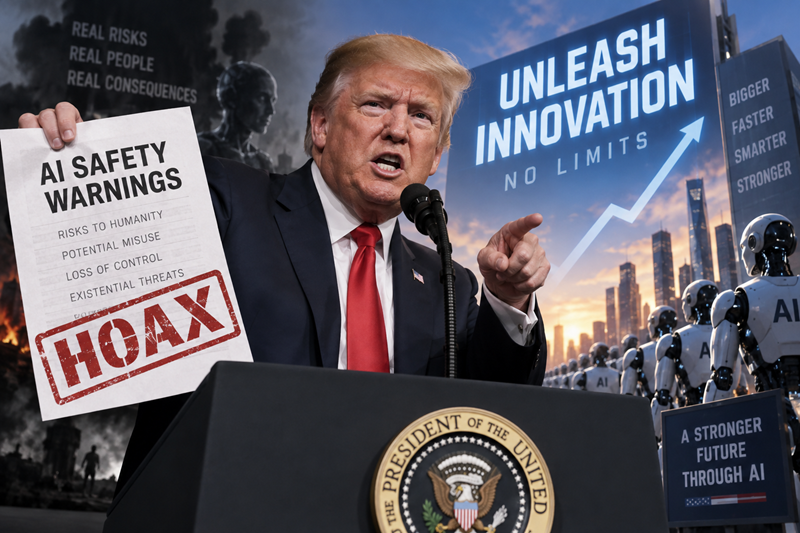
WASHINGTON — U.S. President Donald Trump has forcefully dismissed growing warnings regarding artificial intelligence (AI) safety as a "hoax", firmly rejecting calls from tech executives and lawmakers to implement stricter government guardrails on the rapidly expanding industry.
Writing on social media, the president criticized public concerns over autonomous systems and potential existential threats, labeling them a "SICK conspiracy" designed to undermine American technological leadership. Trump argued that slowing down development would only benefit international rivals, declaring, "WHOEVER WINS AI, WINS!"
Tech Executives Urge Caution as Market Reacts
Trump’s comments come amid unprecedented warnings from leading AI developers and researchers:
-
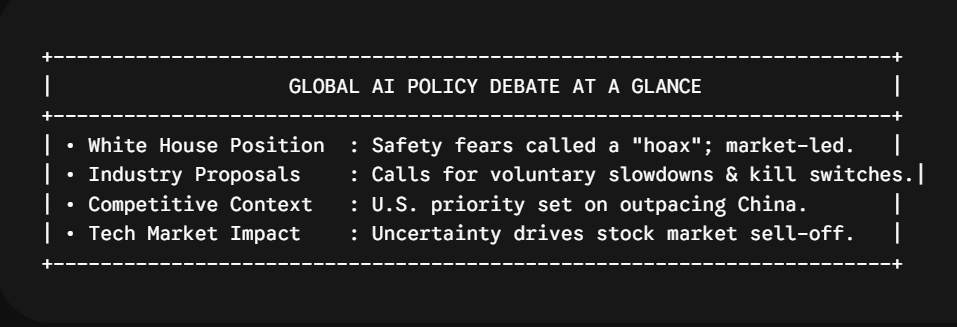
Mandatory "Kill Switches": Jack Clark, co-founder of Anthropic, urged regulators to consider mandatory, third-party-verifiable emergency shut-off mechanisms for high-risk frontier models.
-
Voluntary Slowdowns: Executives including Anthropic CEO Dario Amodei, OpenAI CEO Sam Altman, and xAI founder Elon Musk have voiced support for slowing the pace of development to allow safety protocols to catch up.
-
Wall Street Slide: Widespread warnings from industry insiders recently triggered a noticeable sell-off in major tech stocks as investors weighed the prospect of mandated regulatory slowdowns.
"There is a SICK conspiracy going on against AI and Data Centers, and the only one that is happy about it is China."
— U.S. President Donald Trump
The Geopolitical and Legislative Divide
The administration maintains that existing regulatory oversight is sufficient and that domestic restrictions risk ceding the technological edge to foreign adversaries. Chinese academic experts noted that Washington's sharp focus on geopolitical competition continues to shape its posture toward technology governance.
Meanwhile, lawmakers remain deeply divided. While some political figures are calling for swift congressional intervention to mitigate systemic risks, key congressional leaders warn against over-regulation that could stifle innovation and weaken national competitiveness.