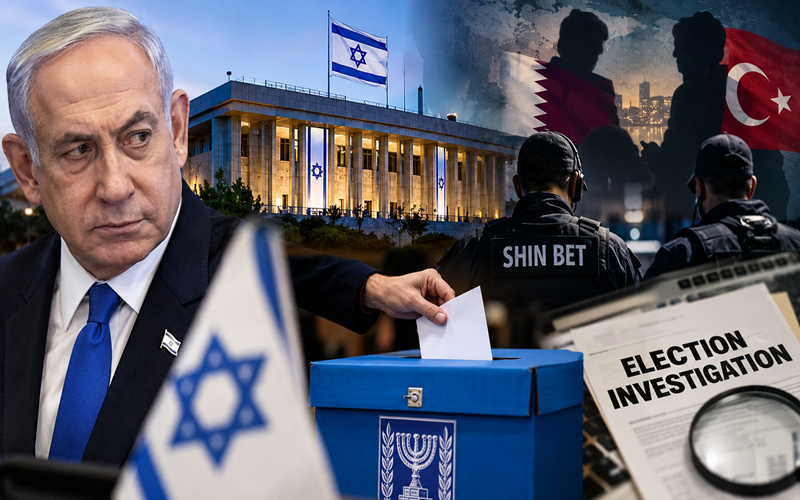
October 29: Israel faces mounting political uncertainty after its domestic intelligence agency launched an investigation into allegations of foreign interference in the parliamentary election, while Prime Minister Benjamin Netanyahu's governing alliance failed to secure the majority needed to remain in power without additional coalition partners.
The investigation, being conducted by Shin Bet in coordination with the Central Elections Committee, centres on suspicions that foreign actors may have attempted to influence Tuesday's vote through financial support and other activities.
Qatar and Turkey have been mentioned in connection with the allegations, although no official findings have established that either country manipulated the election. Qatar has categorically rejected accusations of involvement.
The controversy has intensified as preliminary results show that neither Netanyahu's alliance nor the main opposition grouping has secured the 61 seats required for a majority in Israel's 120-member Knesset.
Netanyahu's Alliance Struggles to Secure Majority
With more than 97 percent of ballots counted, Netanyahu's right-wing and religious coalition was projected to win 53 parliamentary seats, leaving it eight short of a majority.
The principal opposition grouping was expected to secure 48 seats, while Arab political parties were projected to win a combined 19 seats.
Revised projections gave Netanyahu's Likud party 27 seats after it gained one seat at the expense of its ultra-Orthodox ally Shas, which fell to six.
However, the adjustment did not improve the overall parliamentary position of Netanyahu's alliance.
The results have placed smaller political parties in a potentially decisive position, with coalition negotiations expected to determine whether Netanyahu can form another government or an alternative administration emerges.
Intelligence Agency Examines Suspected Foreign Funding
Shin Bet began investigating allegations of foreign involvement following a directive from Central Elections Committee Chairman Supreme Court Justice Noam Sohlberg.
The inquiry reportedly concerns suspected financial activities and possible attempts to improperly influence voters or political organisations.
Shin Bet chief David Zini is expected to brief leaders of major political parties on the investigation.
Israeli media reported that the intelligence agency initially handled the matter discreetly before expanding its inquiries after obtaining information considered sufficiently credible to warrant further investigation.
The probe is expected to examine whether foreign financial assistance reached political actors and whether any such activities violated Israeli election laws.
However, a senior Central Elections Committee official reportedly assessed that the suspected interference, even if proven, was unlikely to have occurred on a scale capable of changing the overall election results.
Qatar Dismisses Allegations
Qatar has denied accusations that it attempted to interfere in Israel's election or provided funding intended to influence the outcome.
Foreign Ministry spokesperson Majed al-Ansari rejected the allegations and accused Israeli political figures and media outlets of spreading misleading information about the Gulf state.
The allegations have nevertheless become a contentious issue in Israeli politics, particularly because of speculation concerning possible foreign financial links to Arab political organisations.
No evidence establishing criminal involvement by Arab party leaders has been publicly confirmed.
Far-Right Minister Demands Arrests of Arab Leaders
National Security Minister Itamar Ben-Gvir has demanded legal action against Arab political leaders suspected of involvement in alleged foreign-funded election activities.
The far-right Otzma Yehudit chairman called on Shin Bet to pursue arrests where sufficient legal evidence exists, including against individuals allegedly connected to Qatari financing.
His remarks have added another dimension to the political dispute surrounding the election.
Israeli police, meanwhile, rejected allegations from Netanyahu's Likud party that Arab parties had stolen the election.
The dispute has highlighted the increasingly confrontational atmosphere surrounding the results, particularly after Arab parties emerged with a potentially influential parliamentary presence.
Opposition Divided Over Possible Government
Although Netanyahu's alliance lacks a majority, opposition parties face their own difficulties in establishing a governing coalition.
Yisrael Beytenu leader Avigdor Liberman has ruled out joining a government headed by Netanyahu or one involving Arab political parties.
He has also rejected cooperation with several ultra-Orthodox political leaders.
Liberman indicated that he would consider a government made up exclusively of Zionist parties, potentially including Likud if Netanyahu were replaced as its leader.
His position presents a major challenge to opposition efforts to unite parties with differing political and ideological priorities.
Ultra-Orthodox Party Signals Possible Shift
Amid the uncertainty, members of United Torah Judaism have reportedly expressed willingness to explore political cooperation with opposition leader Gadi Eisenkot.
Israeli broadcaster Channel 13 reported that some party figures were interested in discussing possible arrangements with Eisenkot despite substantial disagreements over policy.
The reported willingness reflects tensions between sections of the ultra-Orthodox political establishment and Netanyahu.
However, no formal agreement has been reached, and Eisenkot had reportedly not initiated contact with the relevant party representatives.
Any cooperation would require difficult negotiations over religious interests, military service obligations and broader government policy.
Lapid and Golan Seek Opposition Unity
Former prime minister Yair Lapid and Democrats Party leader Yair Golan met Thursday to discuss possible political cooperation following the election.
Their talks focused on coordinating efforts among opposition groups seeking an alternative to Netanyahu's leadership.
Golan subsequently expressed determination to work with political partners to bring about a change of government.
However, significant disagreements remain over the composition of any prospective coalition, particularly regarding participation by Arab and ultra-Orthodox parties.
These divisions could make it difficult for the opposition to translate Netanyahu's electoral setback into a workable parliamentary majority.
Election Results Will Be Published Despite Investigation
The Central Elections Committee has indicated that the ongoing security investigation will not delay the certification and publication of the election results.
A committee source told The Jerusalem Post that the investigation would also not prevent President Isaac Herzog from beginning the process of selecting a political leader to attempt to form a government.
The possibility of ordering another election has been raised in political discussions, but officials consider such speculation premature.
Any attempt to invalidate the election would require evidence of irregularities sufficiently serious to affect the outcome or distribution of parliamentary seats.
Current assessments suggest that nationwide cancellation of the results is unlikely, even if some allegations are substantiated.
Israel Faces Difficult Coalition Negotiations
The election has left Israel confronting a complicated political landscape in which neither major bloc can govern independently.
Netanyahu must seek additional parliamentary support to retain power, while opposition leaders must overcome deep disagreements to build a viable alternative.
The foreign interference investigation adds further uncertainty, although its findings are not currently expected to prevent the formation of a government.
The next phase will depend on the official election results, the progress of the Shin Bet investigation and the willingness of rival parties to negotiate.
With the parliamentary balance remaining sharply divided, Israel could face prolonged coalition talks as political leaders attempt to resolve the deadlock and establish a new government.