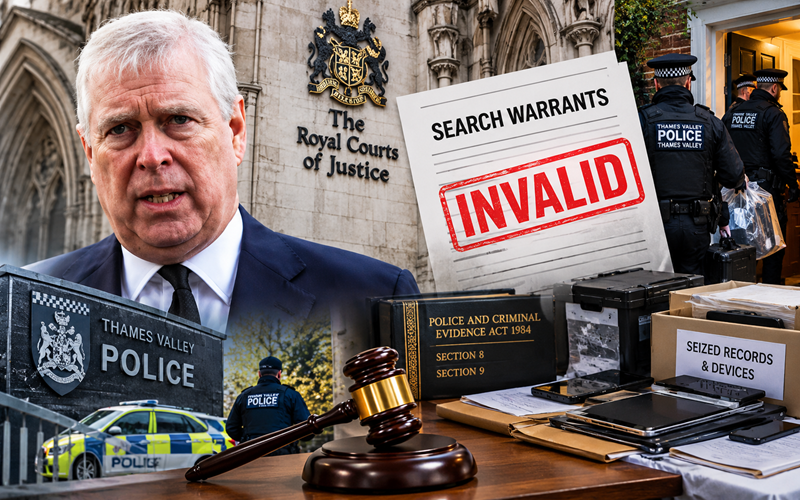
London: Thames Valley Police has conceded during a High Court hearing that the search warrants executed at the properties of Andrew Mountbatten-Windsor earlier this year were legally invalid.
The law enforcement agency acknowledged that the original court applied the incorrect statutory provisions when issuing the warrants ahead of the February 19 raids.
Andrew was previously taken into custody on suspicion of misconduct in public office, an allegation he strongly rejects.
Despite the procedural error regarding the warrants, the overarching criminal inquiry remains active. Legal arguments are underway to determine whether law enforcement may retain the physical records and digital devices impounded during the searches in Norfolk and Berkshire while judicial review proceedings continue.
Lawyers representing Andrew initiated the judicial review to contest the actions of the Central Criminal Court and the force's Chief Constable.
The investigation stems from documents made public by the U.S. Department of Justice hinting that he sent confidential details to the late convicted sex offender Jeffrey Epstein during his tenure as a UK trade envoy in 2010. Andrew has repeatedly maintained his innocence regarding any connection to Epstein's illegal actions.
Core Legal and Procedural Context
-
Statutory Misstep: Investigators sought authorization under both Section 8 and Section 9 of the Police and Criminal Evidence Act 1984 during a Central Criminal Court hearing preceding the raids. However, the presiding court incorrectly issued the warrants strictly under Section 8, whereas legal standards required them to be granted under Section 9.
-
Official Police Position: A spokesperson for Thames Valley Police clarified that the quashing of the warrants reflects a statutory misinterpretation by the court rather than a setback regarding the merits of the inquiry. The force confirmed it followed standard protocols and provided all required documentation during the initial application.
-
Evidentiary Retention: Proceedings are now focused on establishing the regulatory framework governing the seized materials to decide if investigators can legally utilize them as evidence moving forward.
-
Ongoing Investigation: Police reiterated that the broader probe concerning misconduct in public office remains active and that all investigative avenues are being pursued.
The High Court confirmed that setting aside the search warrants does not invalidate the wider criminal investigation, which continues despite the ongoing dispute over evidence retention.