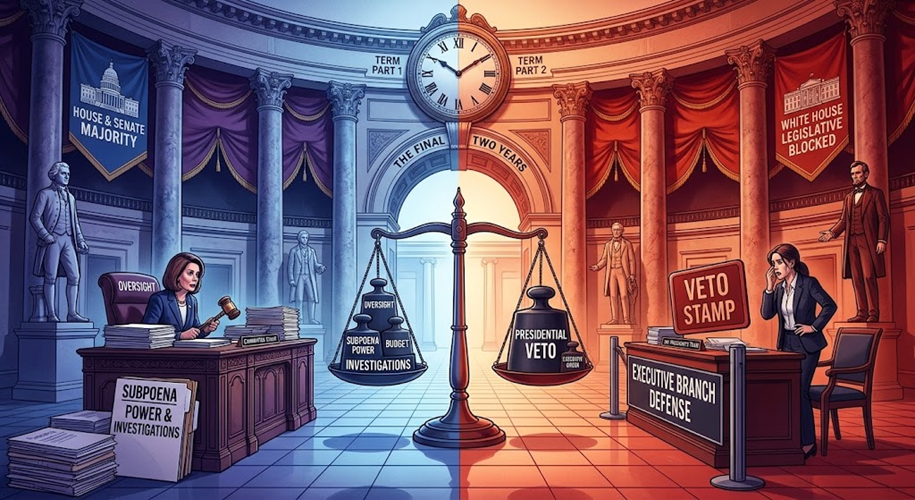
When an opposition party captures majorities in both the House of Representatives and the Senate mid-way through a president's term, it dramatically alters the political dynamics in Washington. This scenario—known as a divided government—forces an executive who once enjoyed unified party rule into a fundamentally defensive posture for their remaining two years in office.
🏛️ The Structural Foundation: Separation of Powers
The United States governs through three distinct branches designed to balance power:
-
The Executive Branch (The White House): Led by the President, who serves as head of state, commander-in-chief, and administrator of executive agencies.
-
The Legislative Branch (Congress): Divided into two distinct chambers:
-
House of Representatives (435 seats): Members serve two-year terms. The House holds exclusive responsibility for initiating revenue bills ("power of the purse") and voting to impeach federal officials.
-
Senate (100 seats): Members serve staggered six-year terms. The Senate is tasked with confirming presidential appointments, approving treaties, and conducting impeachment trials.
-
-
The Judicial Branch (Federal Courts & Supreme Court): Interprets statutes and ensures federal actions adhere to the Constitution.
The Midterm Mechanism
Occurring two years into a four-year presidential term, midterm elections put all 435 House seats and approximately one-third of the Senate up for vote. Midterms frequently serve as a broad national referendum on the sitting president's economic stewardship, legislative record, and executive conduct.
⚡ Operational Shifts Under an Opposition-Controlled Congress
When majorities in both congressional chambers flip to the opposing party, the mechanics of governance undergo an immediate transformation across six primary domains:
1. Legislative Stagnation & Mandatory Compromise
Without control of either chamber, the White House can no longer advance unilateral domestic legislative agendas, tax overhauls, or major spending programs. Any binding federal statute or annual budget requirement demands direct negotiation with opposition leadership (such as the Speaker of the House and the Senate Majority Leader). Failure to reach consensus routinely increases the risk of federal budget impasses and government shutdowns.
2. The Mechanics of the Veto
-
Presidential Rejection: The President retains the constitutional power to veto legislation passed by an opposition-held Congress.
-
Veto Overrides: Congress can bypass a presidential veto only by securing a two-thirds supermajority in both the House and the Senate—an exceptionally high hurdle in modern partisan politics.
3. Expanded Oversight & Subpoena Power
An opposition sweep transfers every committee chairmanship to the opposing party. These committee leaders hold broad oversight capabilities:
-
Congressional Hearings: Committees can systematically investigate executive branch operations, agency spending decisions, and official conduct.
-
Compulsory Subpoenas: Opposition committee chairs possess the legal authority to issue subpoenas for administration records, internal communications, and binding witness testimony.
4. Senate Gatekeeping of Appointments
Because the Senate holds sole constitutional authority to confirm executive nominees, an opposition-held upper chamber can slow down, reshape, or reject presidential nominations for federal judgeships, cabinet positions, ambassadorships, and regulatory agencies.
5. Increased Impeachment Vulnerability
With an opposition majority in the House of Representatives, the barrier to drafting and passing formal Articles of Impeachment lowers considerably, as impeachment requires only a simple House majority vote. However, actual removal from office remains rare, requiring a two-thirds conviction vote in the Senate.
6. Strategic Pivot to Executive Directives
Faced with legislative roadblocks in Capitol Hill, presidents in a divided government typically pivot their focus toward avenues requiring minimal congressional consent:
-
Issuing Executive Orders to direct internal agency enforcement and policy execution.
-
Leveraging discretionary authority in foreign policy, international diplomacy, and trade administration.
📌 Summary
An opposition sweep in the midterms effectively strips the executive branch of its legislative momentum. For the remainder of the presidential term, the White House shifts from setting the nation's legislative baseline to navigating aggressive oversight, protecting key policies via the veto, and managing executive nominees through a hostile Senate.